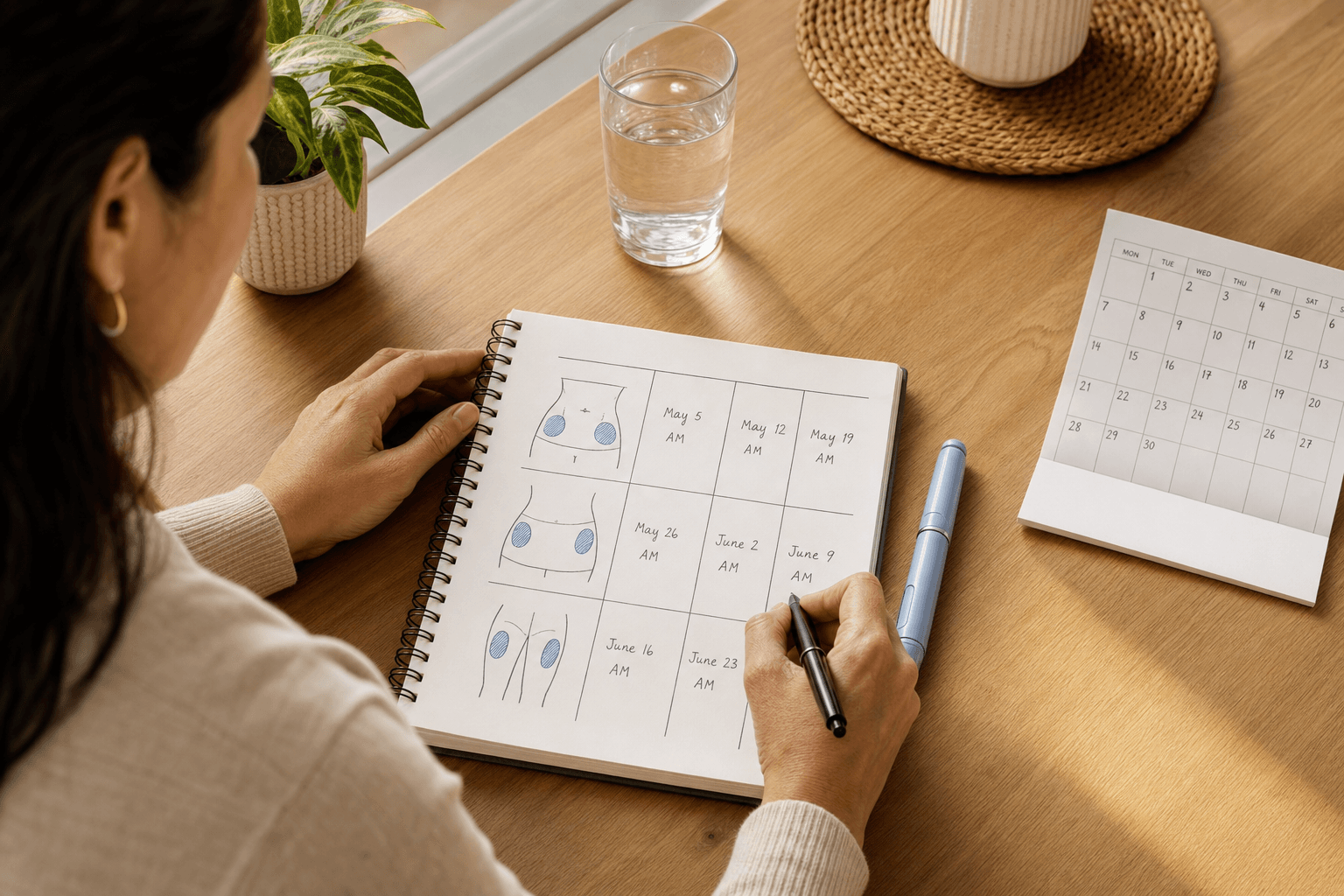
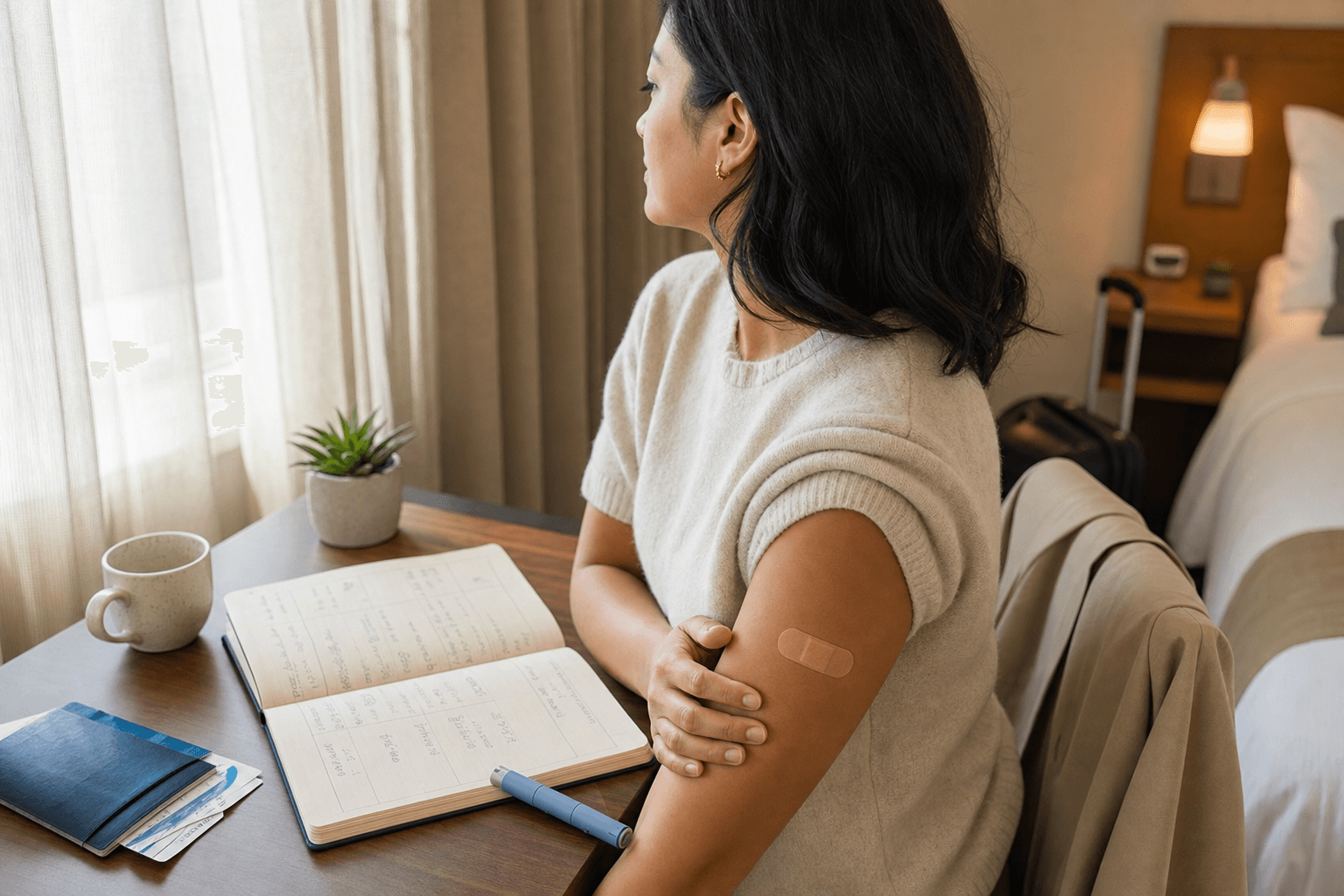
When you travel across time zones, the calendar date of your shot can blur. If you inject on Wednesday morning in New York but fly to London overnight, is that shot logged as Wednesday or Thursday? The confusion matters for your records—especially when you're trying to keep your actual injection schedule steady.
The fix is simpler than it sounds: anchor your log to one consistent timezone or rule, and stick to it. You don't change when you inject. You just decide how you record it.
Why time zones make shot logging confusing
Your GLP-1 routine runs on a weekly cycle, not a calendar. You inject every seven days from your last shot, regardless of where you are. But when you cross time zones, the local date can shift while your actual schedule doesn't.
Example: You take your shot every Wednesday at 8 a.m. in your home timezone. You're traveling and it's Tuesday night local time in Tokyo. You inject at your usual time (which is early Wednesday morning back home). Did you just take a Tuesday shot or a Wednesday shot?
The confusion multiplies when you:
- Look back at your log weeks later and forget which timezone you were in
- Travel frequently and log shots in three different local times
- Try to spot patterns in your records without a clear date anchor
- Sync your shot dates with a calendar reminder set to your home timezone
A clear logging rule removes all of this friction.
Three approaches to consistent time-zone logging
1. Always log in your home timezone
Pick one timezone and use it for every entry, no matter where you are. This is the cleanest method for most people.
How it works:
- Your home timezone is your permanent reference point.
- When you inject, you note the date and time in your home timezone, even if it's a different date locally.
- Your log stays aligned with your calendar reminder and your doctor's records, which are also usually anchored to your home address.
Example:
- You live in Chicago (Central Time).
- You inject on a Tuesday at 7 p.m. Chicago time while in Sydney.
- In Sydney, it's Wednesday 12:30 a.m. local time.
- You log it as Tuesday, 7 p.m. Central Time.
- Your next shot is due seven days later: Tuesday, 7 p.m. Central Time again.
Best for: People who travel occasionally, keep their routine fixed to home time, or want their records to match their doctor's timezone.
2. Log by the date on your pen or packaging
Some people anchor to the physical object instead of a timezone. Your pen or vial has a date printed on it (the date you filled it, or the date you started using it). You log your shot by that date, regardless of local time.
How it works:
- You ignore the local clock entirely.
- You note only the date printed on your pen or the date you filled it.
- This works well if you pre-fill pens at home before travel or if your pharmacy labels them.
Example:
- Your pen is labeled "Filled: Monday, March 4."
- You inject on Wednesday, March 6, but you're in a timezone 12 hours ahead.
- You log it as "Wednesday, March 6" because that's the date on the pen you're using, not the local date.
Best for: People who travel frequently and want to avoid timezone math entirely.
3. Log by injection day in your routine cycle
Instead of a calendar date, you log by your position in your weekly cycle: Shot #1, Shot #2, Shot #3, etc., or Week 1, Week 2, Week 3. You add the local calendar date as a note, but your primary record is the cycle number.
How it works:
- Your shot log becomes a sequence, not a date list.
- You note "Shot #47" or "Week 8 of my routine" as the primary entry.
- You add the local date as a note for reference, but it's not your anchor.
- Your next shot is always exactly seven days after your last shot, by the clock.
Example:
- You're on Shot #23 of your routine.
- You inject at your scheduled time while traveling.
- You log it as "Shot #23, injected Tuesday, March 5 (local date: Wednesday, March 6, Sydney time)."
- Your next shot is Shot #24, seven days later.
Best for: People who travel frequently, change timezones often, or prefer to think of their routine as a sequence rather than a calendar.
How to set up your rule before you travel
Decide your approach now, while you're still home. Write it down or save it in a note.
- If you choose home timezone: Write down your home timezone abbreviation (EST, PST, GMT, etc.). When you travel, check the time difference and do the math before logging.
- If you choose pen date: Photograph your pen label or packaging before you travel. Keep the photo in your phone.
- If you choose cycle number: Start numbering your shots from today. Each shot gets a sequence number. Write the rule in your app notes: "Log by shot number; local date is reference only."
Keeping your notes clear during travel
Once you've chosen your rule, add a note to your shot record that explains what you did. This prevents confusion when you review your log months later.
Example notes:
- "Shot logged in Central Time (home timezone). Local time was 12:30 a.m. Wednesday in Sydney."
- "Pen labeled March 5. Injected at 7 p.m. local time Wednesday, March 6, Tokyo time."
- "Shot #24 of routine. Injected 7 p.m. Tuesday, March 5, Chicago time. Local date was Wednesday, March 6, Sydney."
A one-line note takes five seconds and saves you from re-figuring out your own log later.
Staying on schedule across time zones
Your injection time stays the same—that's the whole point. You don't move your shot earlier or later just because you crossed a time zone. You inject at your usual time, log it consistently, and move on.
If you normally inject at 7 p.m. on Wednesdays:
- In London, that's midnight Wednesday-to-Thursday. You inject at midnight.
- In Tokyo, that's 4 a.m. Thursday. You inject at 4 a.m.
- Back home, it's 7 p.m. Wednesday. You inject at 7 p.m.
Your body doesn't know the local time. Your routine is seven days between shots, measured from your clock—not from the calendar date.
Using Dose AI to log across time zones
Dose AI lets you record the exact date and time of each shot, then add a note explaining your timezone context. When you log a shot while traveling, you can:
- Enter the date and time in your chosen anchor (home timezone, pen date, or cycle number).
- Add a note: "Logged in home timezone" or "Local date: [date]" so you remember what you did.
- Set your next reminder for exactly seven days later, in your home timezone.
The Notes field is perfect for travel clarity. A quick note prevents confusion when you scroll back through your log in three months.
FAQ
How do I know what time zone to use if I'm traveling for weeks?
Pick one before you leave. If you're traveling for a month and crossing multiple zones, anchor to your home timezone or your pen date. Don't switch anchors mid-trip. Consistency matters more than which rule you pick.
What if I forget whether I logged a shot in home time or local time?
Add a note to every shot you record while traveling. Write "Home timezone" or "Local date: [date]" so you can check later. A one-line note takes seconds and saves hours of confusion.
Does changing time zones affect when I should inject?
No. You inject at the same time every seven days, measured by your clock. Time zones don't change your routine. They only change what the local calendar date is. Keep your injection time steady; the calendar date will shift depending on where you are.
Can I use Dose AI to set reminders in multiple time zones?
Dose AI reminds you based on the timezone of your phone. If you change your phone's timezone when you travel, your reminder times will shift. To keep reminders on your home schedule, leave your phone in home timezone or manually adjust the reminder time to match your home clock.
What if I travel so much that "home timezone" doesn't make sense?
Use your pen date or shot cycle number instead. Log by the date on your pen or by shot sequence (Shot #1, Shot #2, etc.). Both methods work across unlimited time zones because they don't depend on any specific timezone at all.