A flat week won’t read as failure.
Nothing kills GLP-1 motivation like the scale going quiet. Plateau Mode steps in the moment a real stall appears, with your own curve on the same chart as the clinical trial, a concrete week plan, and a buddy who celebrates when you break through.
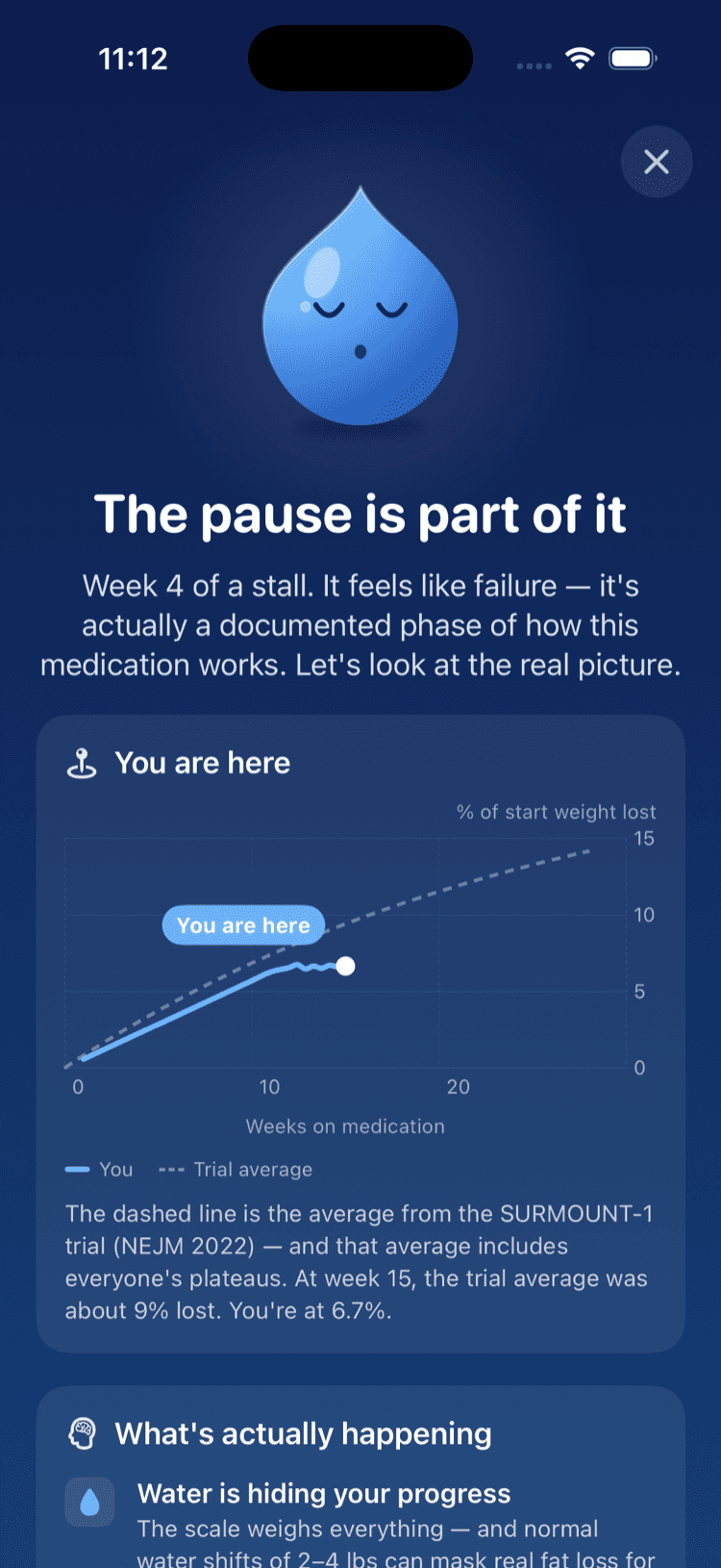
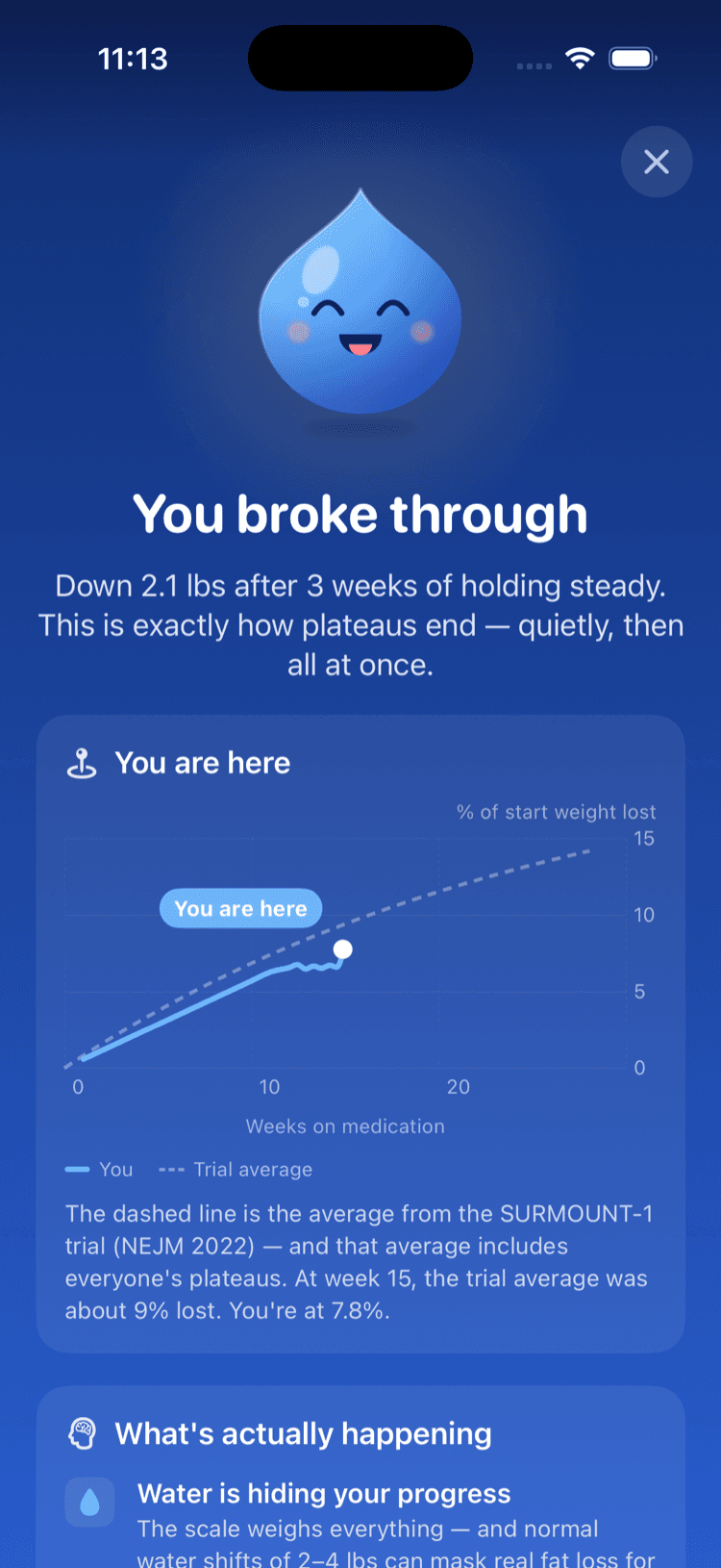
Your curve, on the same chart as the trial.
Almost everyone stalls around week 12. Plateau Mode puts your curve on the trial’s chart, so the stall reads as a phase, not a failure.
The dashed line is the average from the SURMOUNT-1 trial (Jastreboff et al., NEJM 2022 (15 mg arm)), and that average includes everyone’s plateaus. At week 15, the trial average was about 9% lost. You’re at 6.7%.
- Stall detection. Only after two flat weeks of genuine progress. Water-weight noise of 2–4 lb won’t trigger it.
- A week plan. Protein, hydration, movement: specific things to do instead of staring at the scale.
- A note for your prescriber. Your stall summarized with the SURMOUNT-1 source cited, ready for the appointment.
Why a stall is when people doubt the medication.
Without context, a flat scale reads as failure: “the medication stopped working,” “I’m doing something wrong,” “why am I paying for this?” Most people who stop a GLP-1 do it over cost and coverage, but the doubt starts here, in the flat weeks. Plateau Mode exists for the four moments that turn a normal stall into that doubt.
Plateau panic
Scale-only tunnel vision
The 2 a.m. Google spiral
The awkward doctor talk
Your dot on the same curve as thousands of trial participants.
Plateau Mode uses the published average from the pivotal trial for your exact medication. Those averages include everyone’s plateaus, which is the point: a stall is on the curve, not off it.
Then the stall turns into a plan.
Reframing is only half the job. Plateau Mode gives you something to do with the week, and something to bring to the person who prescribes your medication.
A concrete week plan
Non-scale victories
A note for your prescriber
- Automatic stall detection
- “You are here” trial chart
- Non-scale victory log
- Doctor-ready note, cited
And when it breaks, you celebrate.
The moment your weight moves again, Blu catches that too. Confetti, a “PLATEAU: BROKEN” share card with your week number and pounds lost, made for posting, because breaking a six-week stall deserves an audience.
Plateau Mode, answered.
What GLP-1 users ask when the scale stops moving, answered with the trial data.
What is Plateau Mode in Dose AI?
Plateau Mode watches your weigh-ins and opens a full-screen check-in the moment a real stall appears — at least two flat weeks after genuine progress. It shows a "You Are Here" chart of your loss curve against the clinical trial average for your exact medication, gives you a concrete week plan, a place to log non-scale victories, and a ready-made note to bring to your prescriber.
Is it normal to hit a plateau on Ozempic, Wegovy, Mounjaro, or Zepbound?
Yes — around week 12, almost everyone experiences a stall. Plateaus are a normal, documented part of the weight-loss curve in the clinical trials for these medications. The trial averages themselves include everyone’s plateaus. Without that context a stall reads as failure, and that is when doubt about the medication starts.
What is the "You Are Here" chart?
It plots your actual loss curve against the average from the clinical trials for your exact medication — STEP-1 for semaglutide (Ozempic/Wegovy), SURMOUNT-1 for tirzepatide (Mounjaro/Zepbound). Seeing your dot on the same curve as thousands of trial participants reframes the stall: it’s a documented phase, not a dead end.
How does Plateau Mode know I’m actually stalled?
It waits for a real plateau — at least two flat weeks, and only after genuine progress. Normal water-weight noise of 2–4 lbs won’t trigger it. The goal is to step in before the doubt spiral starts, not to cry wolf every time the scale wobbles.
What do I say to my doctor about a plateau?
Plateau Mode builds a ready-made note for your prescriber, with your data and the relevant trial sources cited — so the awkward "what do I even ask?" conversation becomes a concrete one about dose, protein, and timeline. Never adjust your dose on your own; bring the note to your clinician.
What happens when the plateau breaks?
Your buddy celebrates with you — confetti and a "PLATEAU: BROKEN" share card with your week number and pounds lost, made for posting. Breakthrough detection is automatic, the same way stall detection is.
The plateau is coming. Have a buddy waiting for it.
Download Dose AI free and log your weigh-ins. When the stall shows up around week 12, Plateau Mode will already know what normal looks like.